Prodrome Science™ — Webinar Series
Alzheimer’s, Dementia & Brain Resilience
Cognition, dementia, and the emerging science of brain restoration.
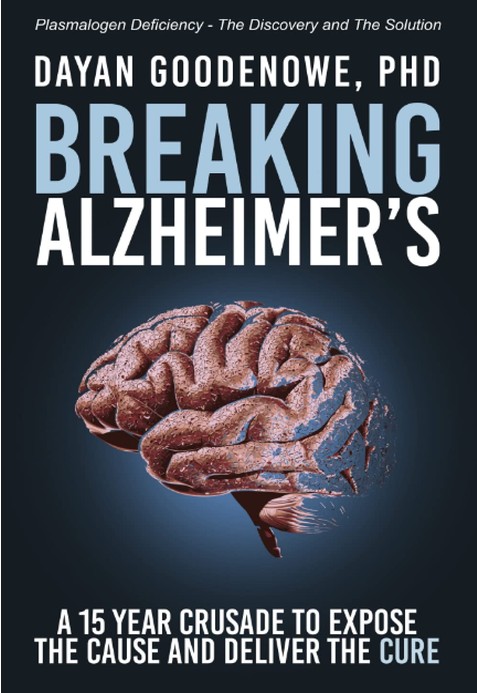
Breaking Alzheimer’s
Breaking Alzheimer’s is Dr. Goodenowe’s account of a fifteen-year scientific journey that began with neurochemistry and ended somewhere he never expected — with a lipid molecule called plasmalogen that he had never heard of and had never been taught about. The discovery that low plasmalogen levels play a central role in Alzheimer’s disease came serendipitously, and has since been validated across fifteen years of research. This book brings that journey into plain language: where the science currently stands, what it means for people living with or at risk of Alzheimer’s, and where it is going from here.
View on Amazon ↗Dr. Goodenowe opens this webinar with a striking claim: “Over ninety percent of what you have read about Alzheimer’s is either flat out wrong or manipulated half-truths.” That’s not hyperbole — it’s his summary of fifty years of misdirected research, backed by studies going back to 1991 that the mainstream narrative has quietly ignored. What follows is the most myth-busting of all his webinars, and in many ways the most hopeful.
“Amyloid plaques and neurofibrillary tangles do not cause dementia. Reduced cholinergic neurotransmission causes dementia. It really is that simple — if cholinergic neurons are firing, you’re going to be thinking. When they stop firing, you stop thinking.”
The obvious vs. the true
Dr. Goodenowe uses a memorable analogy to frame the Alzheimer’s research problem. For most of human history, he notes, it was obvious that the earth was flat — you could see the sun rise in the east and set in the west. The truth (a speck of dirt orbiting a ball of fire) was not obvious at all. “The goal of science is to understand the difference between what’s obvious and what is true.”
In Alzheimer’s, the obvious story has been this: a healthy neuron gets infected with neurofibrillary tangles, amyloid plaques cloud the area around it, and the neuron dies. It’s visually compelling. It’s been the basis of drug development for decades. And according to Dr. Goodenowe, it’s wrong.
He cites a 1991 postmortem study of 2,661 human brains — Brock & Brock — which found that nerve cells within amyloid deposits appeared “virtually unchanged” and that there was “no evidence of amyloid toxicity in humans.” More striking: in the hippocampus, while 60% of neurons were lost in Alzheimer’s, only 8.1% of those degenerated neurons had any evidence of neurofibrillary tangles. In other words, the vast majority of neuron death in Alzheimer’s happens without tangles being present. And when researchers deliberately put extra tangles inside neurons to prove they were toxic, the neurons remained “completely functionally intact.”
According to Dr. Goodenowe: “There really is no evidence whatsoever that in humans amyloid plaques or neurofibrillary tangles cause dementia. You are not supposed to have plaques and tangles — these are symptoms of an unhealthy brain, for sure — but they don’t cause dementia.”
What actually causes cognitive decline
The real mechanism, he argues, was established in the 1970s and has been quietly confirmed ever since. The brain has a neurotransmitter system — the cholinergic system — that Dr. Goodenowe describes as the “master orchestrator of the brain,” innervating the frontal cortex, parietal cortex, and hippocampus. When this system fires, you think. When it doesn’t, you don’t.
The proof: in 1977, a researcher gave healthy university students in their twenties a drug called scopolamine, which blocks the acetylcholine receptor. The result was immediate memory loss — a twenty-two-year-old with full-blown dementia, pharmacologically induced, with no amyloid, no tangles, no aging involved. When the block was reversed, cognition returned. As Dr. Goodenowe puts it: “In the 1970s it was definitively determined that in humans, reduced cholinergic neurotransmission is causal to dementia.”
And then the critical piece that connects to his broader research: the cholinergic neurons’ ability to fire depends on membrane fusion — the process by which neurotransmitters are released into the synapse. And membrane fusion requires plasmalogens. According to Dr. Goodenowe, “those membranes need to have over seventy-five percent plasmalogens in them to function. As soon as the plasmalogen composition gets less than seventy-five percent, membrane fusion goes way, way down.” Declining plasmalogen levels mean declining acetylcholine release means declining cognition. That is the chain.
Why the brain shrinks — and what it’s actually losing
Most people assume that when the brain shrinks in Alzheimer’s, it’s losing neurons. According to Dr. Goodenowe, that’s not quite right. “What causes this brain to shrink is a loss of fat. Your brain is a big ball of fat, and when it shrinks — like a grape shrinks into a raisin when it loses water — when your brain shrinks it loses fat. And the main composition of fat in the brain is these phospholipids.”
The mechanism he describes is what he calls “autocannibalism.” When a cholinergic neuron can’t recycle the choline it needs to keep making acetylcholine, it starts cannibalising its own membrane phospholipids to get it. “Just like your body can be muscle-wasting if you starve yourself — you’re eventually going to take your muscles and your fat and you’ll get skinnier and skinnier and weaker and weaker — this is basically starvation of a cholinergic neuron. Its muscles and its fat shrink.” The neurons don’t die first. They shrink. And shrunken is not the same as dead.
This is the basis for one of the most hopeful findings in the webinar. A 1990 study of the nucleus basalis — the region of the brain where cholinergic neurons live — found that in Alzheimer’s, the cell bodies were shrunken but largely intact. In Dr. Goodenowe’s words: “Cholinergic neuron cell bodies are shrunken, not dead.” The study’s conclusion was that this “renders it likely that cholinergic dysfunction may be responsive to neurotrophic influences.” That was written in 1990. The evidence for restoration was already there, thirty-five years ago.
Why the L-DOPA approach never worked for Alzheimer’s
After L-DOPA produced remarkable results in Parkinson’s by supplying a precursor to dopamine, researchers naturally asked: can we do the same for Alzheimer’s with choline? Supply a choline precursor, restore acetylcholine, restore cognition. According to Dr. Goodenowe, it never worked — and the reason why reveals something fundamental about how cholinergic neurons are different from every other neuron in the brain.
For twenty years, the assumption was that cholinergic neurons take up choline the same way dopamine neurons take up dopamine — through a transporter on the cell surface. Drug after drug was designed around this assumption. Then a group of researchers discovered the transporter didn’t actually sit on the surface of the cell. It sat on the vesicles inside. And this changes everything: a cholinergic neuron can only feed itself when it is actively firing. “Cholinergic neurons cannot actually get fed if they’re not firing. The firing process of a cholinergic neuron is what gives it the ability to feed itself. So if you reduce neurotransmission, you reduce feeding — and you cause shrinkage.”
This is why a simple choline supplement doesn’t restore Alzheimer’s cognition. The neuron can only absorb what it needs through the act of firing — and if it’s already not firing properly, the supplement has no way in. The solution isn’t to supply more choline. It’s to restore the membrane conditions that allow the neuron to fire in the first place. And that, according to Dr. Goodenowe, means restoring plasmalogens.
The two plasmalogen types — and what each does
Dr. Goodenowe describes the plasmalogen precursors he has developed as “premade building blocks for the brain cells to use — it’s like taking a carpenter and supplying them with plywood.” There are two types, and they do different things:
Omega-nine (ProdromeGlia™) — for myelination, white matter structure, and inflammation reduction. Dr. Goodenowe describes this as “the tuning” — it gets the signals of the brain strong and clear, reduces neuroinflammation, and rebuilds the structural membranes. He takes this at night, he says, to support white matter repair during sleep. It’s also a key component of human breast milk, supporting white matter development in infants.
Omega-three (ProdromeNeuro™) — for synaptic function, neurotransmitter release, and cognitive performance. Dr. Goodenowe calls this “the volume” — it makes the signals brighter and thinking stronger. “I took some before I did this webinar,” he mentions in the Q&A. This is the type that directly supports the membrane fusion process that allows acetylcholine to be released — the precise mechanism that drives cholinergic neuron function.
According to Dr. Goodenowe, most clients use both: omega-nine at night to rebuild structure and reduce inflammation, omega-three in the morning to support cognition during the day. For Alzheimer’s specifically, restoring plasmalogen levels addresses both the structural decline of the white matter and the functional decline of the cholinergic synapses — the two mechanisms that drive cognitive loss.
Key ideas — in Dr. Goodenowe’s own words
- Amyloid and tangles are symptoms, not causes. “Reduced cholinergic neurotransmission actually causes amyloids and tangles. Amyloids and tangles do not cause dementia.” According to Dr. Goodenowe, decades of amyloid-targeting drug trials have confirmed this: removing amyloid from the brain has never restored cognition. The cause was never the amyloid.
- The neurons aren’t dead — they’re shrunken. Dr. Goodenowe cites postmortem studies showing that cholinergic neuron cell bodies in Alzheimer’s are not dead but shrunken — deprived of the choline they need to function. “Cholinergic neuron cell bodies are shrunken, not dead.” The conclusion of that 1990 study: this “renders it likely that cholinergic dysfunction may be responsive to neurotrophic influences.” Thirty-five years ago, the evidence for restoration was already there.
- Memories aren’t gone — the retrieval system is impaired. One of the most hopeful points in the webinar: “It’s not the memories themselves that are gone — it’s the memory retrieval system. The acetylcholine system is the cue to play memories back. And so the memories are still there.” This is why, according to Dr. Goodenowe, people with Alzheimer’s can improve — the recordings exist, the player just needs to be restored.
- Inflammation depletes plasmalogens — and this drives brain fog and cognitive decline. According to Dr. Goodenowe, chronic inflammation causes the body to consume plasmalogens faster than it can replace them — “they’re like a fire blanket. Your body sends them out and they get destroyed.” This is why conditions from MS to post-COVID to chemotherapy all produce cognitive impairment: they share a common mechanism of plasmalogen depletion.
- Restoring function restores pathology. “When you restore function, you restore pathology.” Dr. Goodenowe’s position — consistent across all his webinars — is that treating the biochemical root cause reverses the downstream markers, rather than the other way around. Fix the plasmalogen levels, restore the cholinergic firing, and the amyloid and tangles diminish as a consequence.
- The ultimate goal is community-level, free access. Dr. Goodenowe closes with a statement that sets this work apart from commercial drug development: “Our ultimate goal is for these products and services to be free of charge to everybody, because the benefit to society and the reductions in healthcare costs far outweigh the value in selling these products.”
Libby’s case study
The webinar opens and closes with Libby — an Australian woman whose husband Steven noticed memory changes five or six years before the webinar. She was diagnosed with Alzheimer’s through MRI and memory testing. The traditional medical system’s response, in Steven’s words: “No, there’s not much that can be done, I’m sorry.”
Libby & Steven — the Alzheimer’s case study
After years in the traditional system, Steven and Libby found Dr. Goodenowe’s program. In a 25-minute Zoom call, Steven says, “we probably came away with one thing on our side that we never thought we had in the traditional system — hope.” They followed the protocol rigidly: morning, early afternoon, 4pm, and 8pm dosing. They walked daily, meditated, and participated in group sessions in Moose Jaw.
The changes came slowly but consistently. Libby’s temperament stabilized. She became more cognitively engaged and more present in conversation. She returned to pottery — an art she had abandoned as the disease progressed. Her rheumatoid arthritis, which had caused severe hand cramping for seventeen years, improved so dramatically that her specialist “pulled a couple of other surgeons and doctors in” when she saw Libby’s hands at a follow-up. Libby is now almost entirely off her rheumatoid medication.
By the webinar’s follow-up update — more than a year into the protocol — Libby had changed so markedly that her support navigator, Macy, said: “I told her at one point in the interview that she was like the brightest light I’ve ever seen.” She led the entire follow-up conversation herself, where previously Steven had done most of the talking. She and Steven had just returned from a 22-day walking trip in Italy — 400 kilometres. Her next project: planting 250 olive trees on their farm.
In Libby’s own words: “If I can do it, they can do it.”
The broader picture
Dr. Goodenowe closes the Q&A with a reflection that runs through all his work: the science matters, but so does the human element. “People are messy. People are time-consuming. Human beings aren’t just a bowl of soup and biochemistry and sinew and muscle and brain tissue. They need to have a purpose of life. They need to have a reason to be alive.”
Libby’s pottery. Ian’s personality returning. Lisa’s vision. Casen’s brain reconnecting. The common thread across every case study in every webinar on this site is not just the biochemistry — it is what becomes possible again when the biochemistry is restored.
Watch the Full Webinar
Dr. Goodenowe presents the complete neuroscience of Alzheimer’s — including the myth-busting evidence on amyloid plaques, the cholinergic system, and Libby’s case study showing what brain restoration looks like in practice.
Watch on DrGoodenowe.com ↗Opens in a new tab · Free to watch
Prodrome Science™ — Companion Lecture
APOE, Cholesterol & Brain Health — Fact vs. Fear
A companion lecture to the webinar above. If you or a loved one has been told you carry the APOE E4 gene, this section is written for you.
The two lectures are intimately connected. The webinar above explains what drives cognitive decline — plasmalogen loss, cholinergic starvation, membrane failure. This companion lecture explains why one gene — APOE E4 — raises Alzheimer’s risk in the first place, and, more importantly, what can be done about it. Dr. Goodenowe frames the whole talk as “fact versus fear,” because APOE is, in his words, the single most statistically significant genetic association with disease — and one of the most fear-inducing tests a person can take. His goal is the opposite: “to teach people the truth about APOE so that you can live without fear.”
“Having an APOE E4 allele is associated with a high risk of Alzheimer’s. That’s a statistical fact that’s not going to go away. The question is: can you do anything about it — and if yes, then what?”
Direct vs. indirect causation — the hairspray story
Dr. Goodenowe’s central point is that every genetic risk factor is an indirect cause — and that distinction is what turns a frightening test result into an actionable one. He illustrates it with a deliberately silly example. Imagine you find that women get twice as many head rashes as men. Being a woman looks like the cause. But dig deeper and you find women use hairspray twice as often; dig further and only certain brands cause the rash; dig further still and it’s one active ingredient. Once you know that, a woman can simply switch hairsprays and her rash risk vanishes — even though the statistic “women get twice as many rashes” never changes.
According to Dr. Goodenowe, APOE E4 works exactly the same way. The gene doesn’t reach into your brain and cause dementia directly. It alters one specific biochemical function — and it’s that function, not the gene itself, that drives the risk. Find the mechanism, and you can work around the gene.
What APOE actually does
APOE is a gene that codes for apolipoprotein E, one of the body’s cholesterol transport proteins. Two small variations in the gene produce three common versions — E2, E3, and E4 — which differ only in their amino acid makeup. According to Dr. Goodenowe, that small difference changes one thing: how efficiently the protein clears cholesterol out of a cell. E2 is a strong cholesterol exporter, E3 is the “Goldilocks” middle, and E4 has a hard time releasing cholesterol at all — a clean, dose-dependent effect demonstrated in cell studies going back to 2000.
Crucially, he notes this is almost entirely a brain issue. APOE handles roughly 99% of cholesterol transport in the brain but less than 5% in the rest of the body. He compares the peripheral system to an interstate highway — the liver shipping cholesterol long distances — while the brain is “more like Chinatown,” a dense network of little streets where a cholesterol-producing astrocyte sits right beside every neuron, using APOE to hand cholesterol back and forth. That’s why the E4 variant matters so much in the brain and so little in your bloodstream.
The chain of causation — in Dr. Goodenowe’s framing
- APOE E4 impairs cholesterol clearance from brain cell membranes. Cholesterol builds up in the membrane because the cell can’t efflux it efficiently.
- Excess membrane cholesterol drives amyloid. The “bad” beta-secretase enzyme lives in cholesterol-rich membrane regions; the “good” alpha-secretase lives in plasmalogen-rich regions. More membrane cholesterol means more amyloid-generating processing.
- Amyloid is a biomarker, not the cause. Consistent with the webinar above: “Increased brain amyloid is the APOE E4 biomarker of reduced brain health… amyloid is also not the cause of dementia; it’s just a biomarker of something not working.”
- Plasmalogens break the chain. In Dr. Goodenowe’s own research on postmortem brains, only four variables were directly tied to cognition — and APOE genotype was not one of them. The gene acts entirely upstream, through cholesterol and amyloid.
The three-legged race
This is the image that ties the whole lecture to the plasmalogen science above. Dr. Goodenowe describes APOE and plasmalogens as two partners tied together in a three-legged race, both responsible for keeping membrane cholesterol in check. “If you’re an E2 carrier, you’ve got a ringer as your APOE guy, so you can handle a weaker plasmalogen partner. If you’re an E4 carrier, your guy has a limp foot — so the plasmalogen partner has to carry twice the weight.”
The reason Alzheimer’s appears late in life, he explains, is that plasmalogen levels typically start declining in the 50s and 60s. For most of life the two partners keep pace. But as plasmalogens fall, the E4 carrier’s already-limping partner can no longer compensate — “by the time they’re 80, he’s saying, I can’t do it anymore.”
His research bears this out. In a Chicago cohort of 1,205 people (average age 84), dementia rates rose in a strikingly linear fashion by genotype — roughly 7% in E2 carriers, 14% in E3, and 22% in E4. But among E4 carriers specifically, those with high plasmalogens had only 14% dementia versus 37% with low plasmalogens — nearly a doubling of risk based purely on a modifiable factor. When the data was extrapolated to high plasmalogen levels, Dr. Goodenowe reports, “the genotype effect disappears in relationship to Alzheimer’s.”
“APOE genotype and blood plasmalogens are independent and additive — but only one of them is modifiable. I can’t change your genotype, but we can change your plasmalogen levels.”
The cholesterol myth — handle with care
This is the most provocative part of the lecture, and the part where Dr. Goodenowe’s position most directly contradicts mainstream cardiology. He argues that the elevated blood cholesterol commonly seen in E4 carriers has nothing to do with their Alzheimer’s risk — because, as above, brain cholesterol and blood cholesterol are essentially separate systems. “The cholesterol in your blood does not reach your brain; your brain makes its own.” His advice to E4 carriers: “Don’t obsess over your LDL and total cholesterol levels.”
He goes further, citing population studies he interprets as showing that low cholesterol is associated with higher cancer incidence and mortality, and that all-cause mortality is lowest in a total-cholesterol range higher than standard targets. He does not dispute that atherosclerosis is real or that oxidized LDL damages arteries — his argument is that broadly lowering all cholesterol “throws the baby out with the bathwater.”
What Dr. Goodenowe suggests E4 carriers focus on
Rather than fixating on the gene, the lecture points E4 carriers toward the modifiable factors that support healthy cholesterol transport in the brain. In Dr. Goodenowe’s framing, the priorities are:
Modifiable levers, in his words
DHA plasmalogens — described as “the only real antidote to the E4 genotype,” both statistically in his published research and mechanistically in the lab.
Animal-based phosphatidylcholine — from eggs, meat, and liver. He argues the brain requires the animal-source structure specifically; plant-based choline serves the periphery but not the brain as effectively.
Metabolic health — keeping triglycerides low, avoiding a high-sugar diet, and using fasting. Plasmalogens are made in peroxisomes, which he says function best in a fasted state; he notes that good HDL, low triglycerides, and good plasmalogen levels tend to travel together as a “trifecta.”
A baseline brain MRI in your 40s or 50s — E4 carrier or not. “Until you get a good, high-quality brain MRI, you don’t know where you are and you don’t know where you’re going.” He shares that his own MRI revealed an undiagnosed post-concussive injury from childhood that he was then able to address.
The lecture closes on the same note of reassurance it began with. An E4 result is not a sentence: even in his 84-year-old cohort, 78% of E4 carriers did not have dementia, and lifetime risk sits around 50% rather than certainty. “You can be perfectly healthy with an E4 genotype, and you can be perfectly unhealthy with an E3 genotype.” In his summary: “Maintain healthy membrane cholesterol, and APOE has no negative health consequences.”
If you want to dig deeper into the scientific mechanisms of the APOE genes and how they impact the probability of Alzheimer’s disease and cognitive impairment, you can watch this webinar in its entirety on Dr. Goodenowe’s website ↗.
Want to learn more about Dr. Goodenowe’s research or explore how this applies to you?
Get In Touch →► Learn more about Dr. Goodenowe