This section covers the researchers and clinicians whose work informs what you’ll read here — what they found, how they found it, and where the evidence stands. It begins with Dr. Dayan Goodenowe, whose plasmalogen research underlies most of the biochemistry on this site. Others will be added as their work is written up.
Excerpt.
For most of modern medicine, the approach to disease has been to wait for symptoms, then treat them. Dr. Dayan Goodenowe built his career on the opposite idea — that disease is predictable, that it leaves a biochemical signature long before symptoms appear, and that if you can read that signature early enough, you can change the outcome.
He earned his PhD in medical sciences, with a focus on psychiatry, from the University of Alberta in 1994, and began researching the biochemical mechanisms of disease in 1990. In the thirty-plus years since, he has worked as a neuroscientist, synthetic organic chemist, and inventor — designing diagnostic technologies, manufacturing novel biochemical compounds, and mapping the chemistry that separates a healthy body from a diseased one.
A technology that could finally read the body’s biochemistry
Mass spectrometers were already well established by the 1990s, but they had a hard limit: you generally had to know what you were looking for. In 1999, Dr. Goodenowe modified one — a Fourier Transform Ion Cyclotron Resonance mass spectrometer — and patented the result. His design added a filtering stage that sorts incoming molecules by weight and feeds them, in small batches, through a series of measuring cells working in parallel inside a magnetic field.
In plain terms: the machine could now measure thousands of small molecules in a drop of blood at once, without deciding in advance which ones mattered. Those molecules — metabolites, the working chemistry of the body — had never been readable at that scale. This became the foundation of the field he helped pioneer: non-targeted metabolomics.
Using that platform, he analyzed blood samples from tens of thousands of people — of all ages, races, and nationalities, across more than twenty diseases — comparing the biochemistry of healthy individuals against those living with disease. Buried in that data, he found a pattern no one was looking for.
Plasmalogens — the molecule he had never been taught
The most consequential pattern Dr. Goodenowe identified was a deficiency in a little-known class of lipids called plasmalogens — molecules essential to the structure of every cell membrane, found in especially high concentrations in the brain and heart. Remarkably, he had never encountered them in his formal training; they simply emerged from the data.
Plasmalogens themselves were not new. They were first described in 1924, and by the 1990s several research groups had already reported that plasmalogen levels were depleted in the brains of people who had died with Alzheimer’s disease. But that work was done on post-mortem tissue — it could describe the damage only after the fact.
Dr. Goodenowe’s contribution was to move the finding from the autopsy table into the living patient. His 2007 paper in the Journal of Lipid Research reported that the deficiency was measurable in circulating blood, in living people, and that it tracked with dementia across every stage. If a deficit is visible in blood, it can be caught early — and potentially corrected. His work has since been examined by research groups in Japan, Europe, and North America.
Because there is no viable dietary source that restores plasmalogens, he went a step further: he designed and patented targeted plasmalogen precursors — compounds the body can absorb and convert into the plasmalogens it needs.
Over his career, his metabolomic research has explored biochemical signatures associated with a wide range of conditions:
“I believe that disease is predictable, and that the leading cause of death is ignorance — not of symptoms, but of the biochemical truth hiding underneath.”
At a Glance
- PhD, Medical Sciences (Psychiatry focus) — University of Alberta, 1994
- Neuroscientist, biochemist & synthetic organic chemist — 30+ years researching the biochemical mechanisms of disease
- Clinical research expert — author of more than 80 peer-reviewed papers, cited more than 5,700 times
- Inventor holding numerous patents in human biology — spanning mass spectrometry, diagnostics, and therapeutics
- Pioneer of non-targeted metabolomics — and the 1999 mass-spectrometry platform behind it
- Inventor of plasmalogen restoration technologies — targeted plasmalogen precursors
- Founder & CEO of Prodrome Sciences — founder of Phenomenome Discoveries and Dr. Goodenowe Perpetual Health
- Best-selling author of Breaking Alzheimer’s
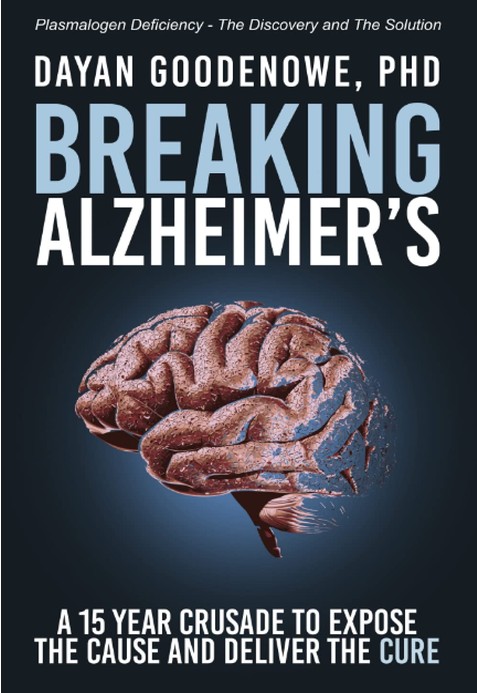
Breaking Alzheimer’s: A 15-Year Crusade to Expose the Cause and Deliver the Cure
Published in 2021, Dr. Goodenowe’s book chronicles the scientific journey behind the plasmalogen discovery — written for a general audience, translating decades of lipid research into plain language.
Beyond disease — toward biochemical reserve
Dr. Goodenowe’s current focus reaches past treating illness. His aim is to build what he calls strategic biochemical reserve capacity — strengthening the body’s underlying chemistry so it can maintain function and resilience across a longer, healthier lifespan. It is the same principle that runs through everything Nexus Health Community shares: go to the cause, and the whole system responds.